
As a Parliamentary panel races to submit its report on the nuclear liability bill, Bharatiya Janata Party appears to have dug its heels asking the government to clarify whether the draft legislation was India-specific or being enacted to fulfil requirements of international treaties.
The Parliamentary panel examining the controversial nuclear liability bill is expected to finalise its report in time for introduction of the draft legislation during the monsoon session beginning July 26. The Parliamentary Standing Committee on Science and Technology, Environment on Forests is examining the Civil Liability for Nuclear Damage Bill, 2010 that was introduced in the Lok Sabha on May 7 amid stiff resistance from a united Opposition.
United States Ambassador to India Timothy J Roemer on Monday called on Bharatiya Janata Party president Nitin Gadkari and is understood to have discussed the nuclear liability bill, which is being opposed by the party. Sources said Roemer called on Gadkari to discuss the Civil Liability for Nuclear Damage Bill and allay apprehensions expressed by the BJP about the proposed legislation. BJP is opposing the Bill.

While the capital spending is being maintained at 3.1 per cent of the GDP, a little more would have boosted economic growth even further, suggests Rajiv Memani.
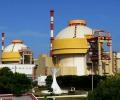
After years of deadlock on liability issue, India and Russia have signed an agreement for building units 3 and 4 of the Kudankulam Nuclear Power Plant project at a cost of Rs 33,000 crore.

India has a 'natural global partnership' with US, says PM.

In first high-level engagement between India and Russia after National Democratic Alliance government came to power, External Affairs Minister Sushma Swaraj and Russian Deputy Prime Minister Dmitry O Rogozin on Wednesday held extensive talks on crucial bilateral issues including trade and energy security.
"What is the need for such a legislation if the public sector and the government will be the only nuclear operators? What is the purpose of this law or of putting a cap on compensation if it is the government which has to pay?" a senior BJP MP said.The BJP fears that once this Bill is passed the government may allow private players later by effecting an amendment only regarding entry of private operators while leaving the Rs 500 crore compensation cap intact.

Bharatiya Janata Party General Secretary Arun Jaitley talks to Aditi Phadnis about the party's differences with the government
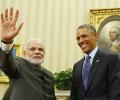
With their landmark 2005 civil nuclear deal still in limbo, India and the United States have established an inter-agency contact group to sort out outstanding liability and technical issues to fast-track its full implementation.
In a major relief to component suppliers in the nuclear energy sector, the government on Tuesday said they will not have any "obligation" if there is any liability. However, the major suppliers, for instance companies building the reactors, will not be absolved if there is such an eventuality.

'There has definitely been a breakthrough in the nuclear logjam. It is good to see nuclear energy back on the rails,' says Dr Anil Kakodkar, former chairman, Atomic Energy Commission.

The reality is that far from being friendless, India is better positioned in the world than at any point post-Cold War, asserts Shekhar Gupta.
The Civil Nuclear Liability Bill is likely to come up for consideration in Parliament on Wednesday

Weeks after 'breakthrough', substantial work is yet to be done
Left parties on Wednesday warned the government that it would commit an "illegal act" if it tried to dilute the Civil Nuclear Liability Act or signed any agreement for supply of nuclear reactors during the upcoming United States visit of Prime Minister Manmohan Singh.
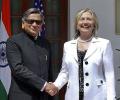
US Secretary of State Hillary Clinton after the second round of Indo-US Strategic Dialogue with her counterpart S M Krishna, made it very clear that there were "issues" which required to be resolved by the two sides in the civil nuclear field. But she did not go into the specifics.
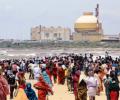
How on earth did Dr Manmohan Singh and his ministers conclude that the casualties of a disaster in a nuclear plant would be fewer than the deaths and injuries caused by the Bhopal gas tragedy? And that the compensation could, therefore, be capped at a smaller amount, asks T V R Shenoy.

The agreement was reached in intensive negotiations between contact groups that Obama and Modi had set up in September.

Prime Minister Narendra Modi and United States President Barack Obama will meet on Sunday, January 25, at Hyderabad House a few hours after the American leader's arrival in New Delhi.

Several nuclear power projects held up for the lack of such an insurance pool can now be expected to move forward.

India is expected to strongly push for a bilateral totalisation agreement with the US during President Barack Obama's visit later this month.
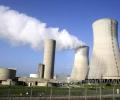
These reactors would bring clean energy to India and generate thousands of jobs in the US
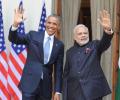
Modi and Obama surely put India-US ties in fast-forward mode. But 5 things deserve careful attention.

He had come in search of jobs in America to rescue his presidency and India failed him in more ways than one, observes Ambassador T P Sreenivasan.
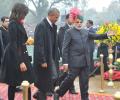
'Reviving the nuclear deal was crucial before the Obama visit... It was time for the BJP to admit that it was wrong, and redo the civil nuclear liability laws.'

Prime Minister Narendra Modi and US President Barack Obama on Sunday held talks on a range of crucial issues, including removing hurdles in operationalising the long-stalled civil nuclear agreement and enhancing ties in defence, trade and commerce and climate change.

'Modi's investment in the relationship with Washington is the biggest deliverable of this visit. He means business and that's fantastic!'
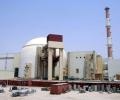
The contract would give a big boost to India's $150 billion nuclear power programme, and a broader push to curb greenhouse gas emissions.

United States President Barack Obama on Sunday arrived in India for a highly anticipated three-day landmark trip during which the two countries will strive to make progress on climate change, defence and economic cooperation.
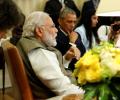
Seeking to boost the strategic ties, India and the US finalised the text of the Logistics Exchange Memorandum of Agreement.
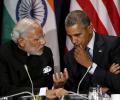
'Big countries do not agree on every set of issues.' 'Look, one of the differences in the relationship is that when we do not agree, we are sitting down and talking to each other.'
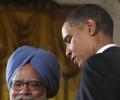
Prime Minister Manmohan Singh departed for an official visit to the United States on Wednesday morning in what could be a last opportunity to recover his crumbling legacy. A host of issues are tied to what could be accomplished on this trip; that the stakes are high is evident from how carefully the government is downplaying whether or not anything can be accomplished.
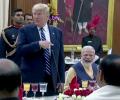
'Many said his visit was very risky. But mercifully, Air Force One has taken off from Delhi without Mr Trump stepping on anybody's toes,' notes Ambassador T P Sreenivasan.

Diplomats agree that amid stormy relations with China and Pakistan, Modi has posted impressive foreign policy successes, notes Aditi Phadnis.
 © 2026 Rediff.com - Advertise with us - Disclaimer - Privacy Policy - Sitemap - Feedback - About us - Terms of use - Grievances